

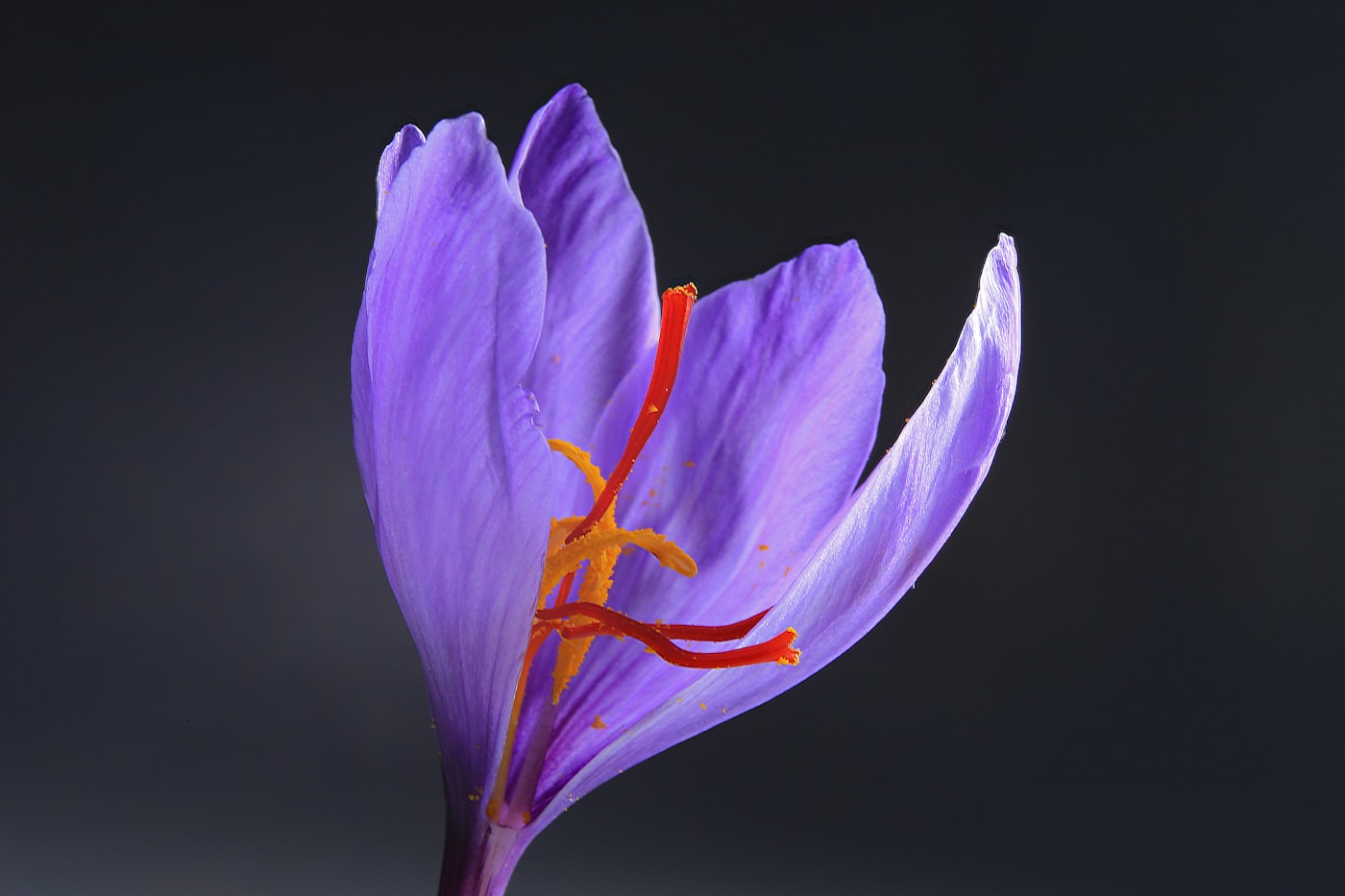
It takes 150,000 flowers and 400 hours of hand-picking to produce one kilo of saffron. Each flower gives just three little red threads. In BIORYA, we don't use kitchen saffron: we use Moodreal®, an extract made in Spain, checked batch by batch so every capsule contains exactly the same richness.
1. Its ID card, in short
2. What it does, simply put
Your mood relies on little chemical messengers in the brain — you may have heard of serotonin, often nicknamed the "good mood molecule". When stress or fatigue disturb these messengers, everything feels greyer. Saffron's natural compounds help keep those messengers in balance — gently, without the "flattened" feeling.
A steadier mood
Across multiple studies, people taking saffron extract daily reported a clearly better mood after a few weeks than those on a placebo.
Softer anxiety
The same research shows a real easing of anxious feelings — that background worry that colours the whole day.
Gentle, not sedating
Saffron doesn't knock you out and doesn't create dependence. It supports the terrain quietly, day after day.
It takes a few weeks
Like most plants, saffron works gradually: studies typically see the difference settle in after 2 to 4 weeks of daily use.
3. How seriously has it been studied?
Very. Saffron extract has been tested in dozens of clinical trials, the strictest kind: neither the participants nor the doctors knew who was getting saffron and who was getting a placebo. Result, confirmed by several combined analyses: a real, measurable effect on mood and anxious feelings in people going through low periods.
4. Why Moodreal® and not just any saffron
Saffron is the most counterfeited spice in the world — and its richness varies enormously from harvest to harvest. Moodreal® is an extract designed for supplements: each batch is analysed and adjusted so the two key compounds (the ones that give saffron its colour and its effect) are always present at the same level. Same quality in January as in August, in your first box as in your tenth.
Educational content, not medical advice. If your mood has been low for several weeks, or if it's affecting your daily life, talk to a healthcare professional. A supplement supports — it never replaces care.
5. Its place in the BIORYA ritual
In CALM AUTHORITY, saffron is the heart of the formula: it looks after the mood over the weeks, while L-theanine brings calm to the day and rhodiola builds endurance. Taken every morning with the 60-second ritual, it's the ingredient you thank at the end of the month — when you realise the grey days have become rarer.
6. Sources
- Hausenblas H. A. et al. (2013). Saffron (Crocus sativus L.) and major depressive / anxiety symptoms: a meta-analysis. J Integr Med.
- Lopresti A. L., Drummond P. D. (2014). Saffron (Crocus sativus) for depression: a systematic review of clinical studies. Human Psychopharmacology.
- Akhondzadeh S. et al. (2005). Crocus sativus L. in the treatment of mild to moderate depression: a double-blind, randomised trial. Phytotherapy Research.
- Hosseinzadeh H. et al. (2009). Effects of safranal on anxiety — preclinical work on GABA receptors. Phytomedicine.
- Natac (Moodreal®). Standardisation and batch quality documentation, ISO 3632.
Want saffron to look after your mood, within a simple daily ritual?